
· Glossary · 3 min read
What Is a Monolith?
A monolithic architecture is a traditional model where an entire application is built as a single, unified unit, offering simplicity for smaller teams but posing challenges for scalability and independent deployments.
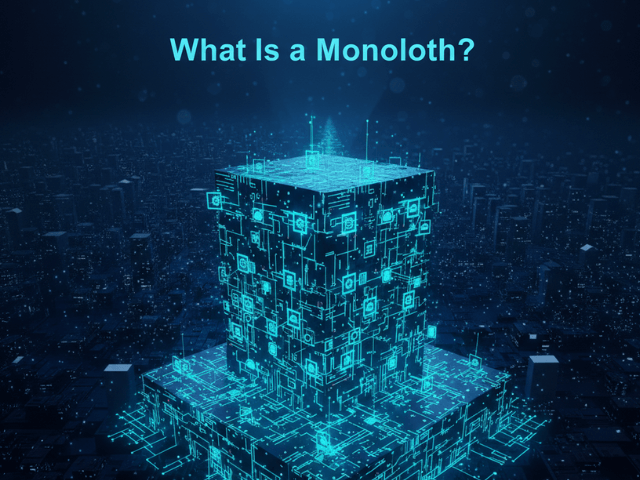
In software architecture, the term “Monolith” sounds scary. It sounds like something prehistoric. But for many companies, the Monolith is the best way to start.
Simple Definition
A Monolithic Architecture is a traditional model where the entire application is built as a single, unified unit. This means the user interface, the database access code, the business logic, and the server configuration are all in one project. They are compiled together. They are deployed together. If you change one line of code in the “Shopping Cart” module, you have to redeploy the “User Profile” module too, because they are part of the same executable file.
Single Codebase, Single Deployment
Think of it like a Swiss Army Knife. It has a knife, a corkscrew, and a screwdriver. But they are all attached to the same handle. You cannot lend the knife to a friend while you use the corkscrew. In a Monolith, everything shares the same memory space. Function calls between modules are instant because they happen in-memory, not over a network.
When to Use a Monolith
Despite the hype around microservices, monoliths are still valid.
Simplicity for Startups
If you are a team of three developers building an MVP (Minimum Viable Product), a Monolith is usually the right choice. It is simple. You have one repo. You have one deployment pipeline. You have one database. Debugging is easy because you can trace the code from start to finish in a single IDE window. You do not need complex orchestration tools like Kubernetes. You just need a server.
Visualizing a Monolith
How do you draw a Monolith?
A single large box with internal modules
In a system architecture diagram, a Monolith is often represented as a single large rectangle. For an example, see Microservices vs. Monolith: Visualizing the Migration. Inside that rectangle, you might draw smaller boxes to represent the internal modules (e.g., “UI,” “Business Logic,” “Data Layer”). This visual weight communicates the architecture clearly. It shows “This is one big thing.” Compare this to a Microservices diagram, which looks like a spiderweb of many small boxes. The Monolith diagram looks like a block.
Related Terms
To understand the tradeoffs, you should know these terms.
- Microservices: An architecture where the app is split into small, independent services.
- Legacy Code: Older codebases that are often Monolithic and difficult to maintain.
- Refactoring: The process of restructuring existing code, often used to break a Monolith apart.
- Modular Monolith: A hybrid approach where the code is in one repo but strictly separated into clean modules to prevent spaghetti code.
For more on visualizing the transition from Monolith to Microservices, check out our Developer’s Guide: The Programmable Diagram: A Developer’s Guide to D2 and Text-Based Visuals.