· Glossary · 3 min read
What Is Asynchronous Communication?
Asynchronous communication allows a sender to transmit a message without waiting for an immediate response, decoupling systems and improving performance for tasks like email queues and heavy processing.
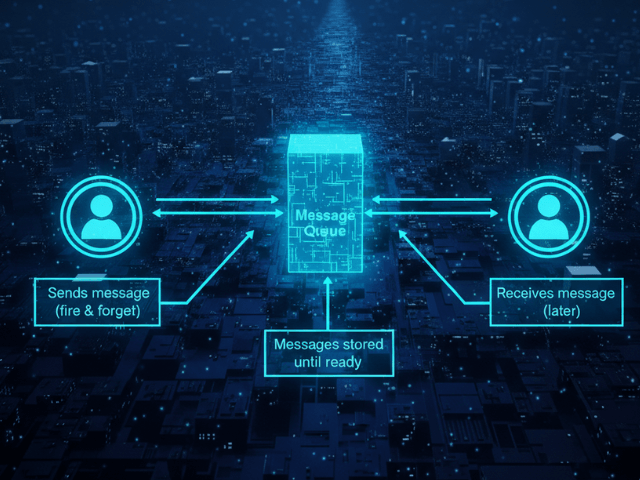
Imagine calling a friend. You talk. They listen. They talk back. If they do not answer, you hang up. That is Synchronous. Now imagine sending an email. You hit send. You go do something else. Maybe they reply in five minutes. Maybe tomorrow. You do not sit there staring at the screen waiting. That is Asynchronous. In software architecture, understanding this difference is critical for performance.
Simple Definition
Asynchronous communication is a method of exchange where the sender and the receiver do not need to be active at the same time. The sender sends a message and continues its work without waiting for an immediate response.
Fire-and-Forget Messaging
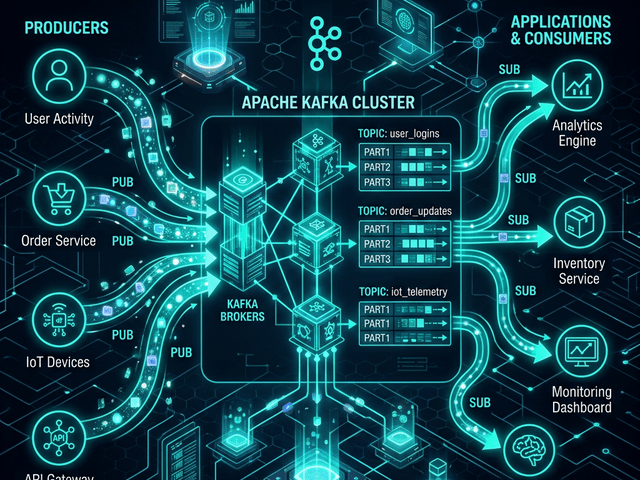
In systems design, we often call this “Fire-and-Forget.” A service puts a message on a queue (like RabbitMQ or Kafka) and moves on. It trusts that eventually another service will pick up that message and process it. This decouples the systems. If the receiver is offline or slow, it does not slow down the sender.
Use Cases
When should you use Async?
Email queues, heavy processing
If a user signs up, you want to show them the “Welcome” screen instantly. You do not want them to wait 5 seconds while your email server connects to Gmail. So you trigger the email asynchronously. The “Sign Up” process finishes fast. A background worker sends the email later. It is also used for heavy tasks like video transcoding or report generation.
Visualizing Async Flows
Async flows are harder to debug because they do not happen in a straight line. You need to map them.
Open arrowheads in Sequence Diagrams
In a sequence diagram, we have a specific symbol for this.
- Synchronous Call: A solid line with a filled arrowhead. (I am waiting for you).
- Asynchronous Message: A solid line with an open arrowhead (just the lines, no fill). (I am sending this and moving on). You might also see a slanted line indicating that the message takes time to travel. Seeing these open arrowheads tells a developer “Okay, I do not need to wait for a return value here.”
Related Terms
To design distributed systems, you should know these terms.
- Synchronous: The opposite of Async. Blocking communication.
- Message Queue: A software component (like Kafka or SQS) used to store async messages until they can be processed.
- Event Bus: A pipeline that transports messages between services.
- Callback: A function that gets called when an async task is finally finished.
For more on visualizing these complex flows, check out our Developer’s Guide: The Programmable Diagram: A Developer’s Guide to D2 and Text-Based Visuals.