· Glossary · 2 min read
What Is Eventual Consistency?
Learn what Eventual Consistency is in distributed computing. It guarantees that if no new updates are made, eventually all accesses will return the latest value.
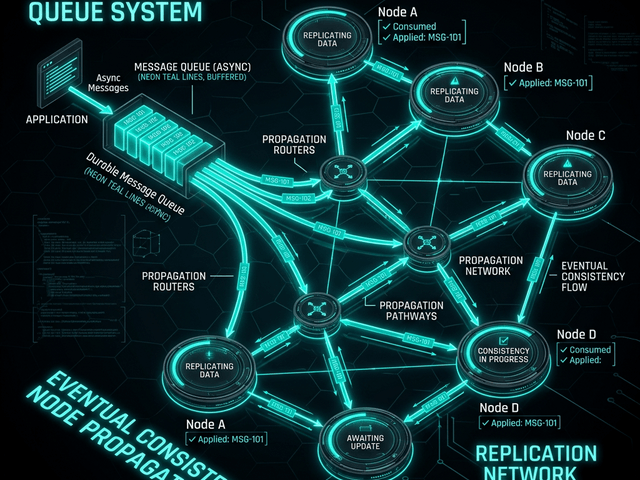
If you update your profile picture on Facebook and your friend sitting next to you doesn’t see it immediately that is not a bug. That is a design choice.
That is Eventual Consistency.
Simple Definition
Eventual Consistency is a consistency model used in distributed computing. It guarantees that if no new updates are made to a given data item eventually all accesses to that item will return the last updated value.
It means the system is allowed to be temporarily inconsistent.
Node A knows the new value. Node B still has the old value. But give it a few seconds (or milliseconds) and Node B will catch up.
The system will become consistent over time.
This model prioritizes Availability over Consistency (see the CAP Theorem). By not forcing every node to agree instantly the system can respond faster and stay online even if parts of the network are broken.
Use Case
When is it okay to be wrong for a few seconds?
Social media feeds vs Bank balances
- Social Media: It doesn’t matter if your Like count is 99 or 100 for a few seconds. Speed matters more. Use Eventual Consistency.
- Banking: It matters a lot if your balance is $0 or $1000. You cannot withdraw money you don’t have. Use Strong Consistency.
Visualizing
How do you show this delay in a diagram?
Async message queues
In an Event Driven Architecture Diagram you show the propagation path.
- Service A updates Database A.
- Service A sends a message to a Queue.
- Service B reads the Queue and updates Database B.
The Queue represents the “Eventual” part. The visual separation between DB A and DB B makes it clear that they are not synchronized instantly.
Related Terms
To understand data synchronization you need these terms:
- Strong Consistency: The opposite model where every read returns the most recent write instantly.
- Replication Lag: The time delay between data being written to the primary node and appearing on the secondary node.
- Conflict Resolution: The logic used to decide which update wins if two people change the same data at the same time.
For more on visualizing data flows check out our System Design Guide.