· Glossary · 2 min read
What Are ACID Transactions?
Learn the fundamentals of ACID transactions (Atomicity, Consistency, Isolation, Durability) and why they matter for financial and enterprise systems.
When you transfer money from Account A to Account B two things must happen.
- Subtract money from A.
- Add money to B.
If the power goes out after step 1 but before step 2 the money disappears.
ACID Transactions prevent this disaster.
Simple Definition
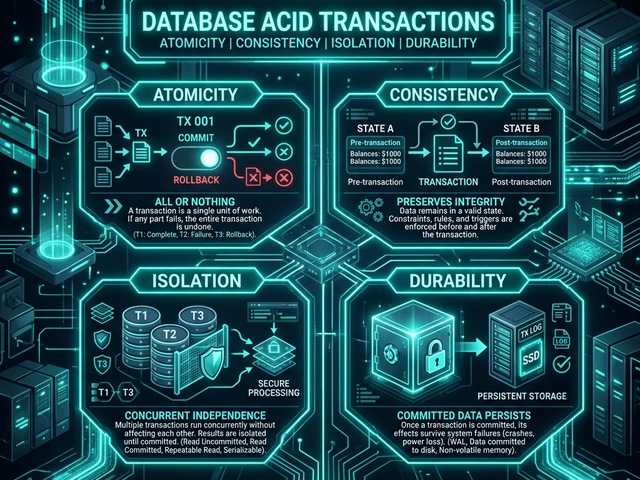
ACID is an acronym that describes the four key properties of a transaction in a relational database that ensure data validity despite errors.
- Atomicity: All or nothing. Either both steps happen or neither happens. If step 2 fails step 1 is rolled back.
- Consistency: The database moves from one valid state to another valid state. It enforces rules (like “Balance cannot be negative”).
- Isolation: Transactions happening at the same time don’t interfere with each other.
- Durability: Once the transaction is committed it stays saved even if the server crashes immediately after.
Why It Matters
These properties are the bedrock of financial and enterprise systems.
Financial integrity
Without ACID you cannot build a bank. You cannot build an inventory system. You cannot build anything where data accuracy is non-negotiable.
This is why traditional SQL databases (like MySQL or Postgres) are still dominant. They provide ACID guarantees out of the box.
Visualizing
ACID is abstract but you can visualize the boundary.
In a Sequence Diagram you can draw a box around a group of interactions and label it “Transaction Scope.”
This tells the developer: “Everything inside this box must succeed or fail as a unit.”
Related Terms
To understand data safety you need these terms:
- Transaction: A unit of work performed within a database management system.
- Rollback: The action of reversing a transaction that failed ensuring no partial data is saved.
- Commit: The action of finalizing a successful transaction.
- BASE: The alternative model used by NoSQL databases (Basically Available, Soft state, Eventual consistency) which trades ACID for speed.
For more on visualizing database logic check out our System Design Guide.